Continuous and accurate patient monitoring is the cornerstone of modern clinical practice. Whether in an operating room, intensive care unit, post-anesthesia care unit, or general ward, clinicians depend on real-time physiological data to make life-critical decisions within seconds. Two of the most fundamental parameters in that data stream are peripheral oxygen saturation and arterial blood pressure. At Zhejiang SuJia Medical Device Co., Ltd., our Monitoring Category is built around precisely these two parameters, offering a Disposable SpO2 Sensor and a Disposable Blood Pressure Sensor designed to deliver clinical-grade accuracy while meeting the strict hygiene and cross-infection-prevention standards that modern hospitals demand.
Founded in 1992 and headquartered at No. 168 Zhenxing Road, Jiaxing, Zhejiang, China, SuJia Medical has grown from a pioneer of the disposable anesthesia puncture kit to a diversified medical disposable manufacturer ranked among the top three players in China's anesthesia and patient monitoring consumable sector. With over 110,000 m² of ISO-certified Class 100,000 clean-room manufacturing space, more than 180 professional technicians, and annual sales reaching approximately 800 million USD, our facility is equipped to serve both domestic and international healthcare procurement at scale. Products in our monitoring line carry CE certification for the European Union and have been evaluated against FDA requirements for the United States market, reflecting our commitment to global compliance. Explore our full company background on the About page for a deeper look at our development history, certifications, and corporate vision.
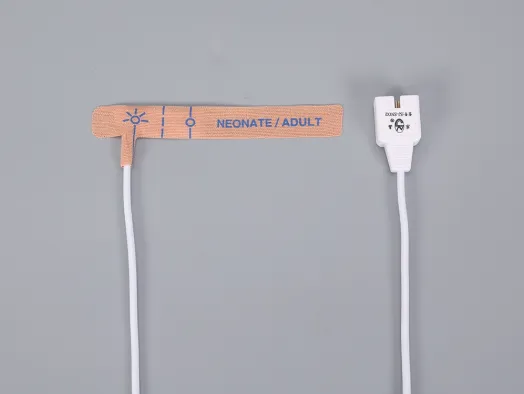
Pulse oximetry has become one of the most widely used noninvasive monitoring modalities in clinical medicine, and the sensor that makes it possible is far more sophisticated than its small, lightweight form factor suggests. A Disposable SpO2 Sensor operates on the principle of photoplethysmography (PPG) combined with spectrophotometric analysis. The sensor housing contains at least two light-emitting diodes (LEDs) — one emitting red light at approximately 660 nm and one emitting near-infrared (NIR) light at approximately 940 nm — positioned opposite a silicon photodetector across a perfused tissue bed, typically the fingertip, toe, or earlobe.
Oxygenated hemoglobin (HbO2) and deoxygenated hemoglobin (Hb) have distinctly different absorption coefficients at these two wavelengths. HbO2 absorbs more NIR light and less red light, while Hb absorbs more red light and less NIR light. By measuring the ratio of pulsatile (AC) to non-pulsatile (DC) components of the transmitted light at both wavelengths, the monitor's algorithm derives a ratio R, which is then mapped against empirically calibrated curves to produce the SpO2 reading. In clinical settings, SpO2 readings between 95% and 100% are generally considered within normal range, while values below 90% signal significant hypoxemia requiring immediate intervention.
SuJia's disposable finger clip and wrap-style SpO2 sensors are designed with medical-grade silicone or soft foam substrates that conform to a wide range of patient anatomies — neonatal, pediatric, and adult — without causing pressure injuries during extended monitoring periods. The adhesive or wrap mechanism is engineered to maintain consistent LED-to-detector optical alignment under patient movement, which is a primary cause of motion artifact in pulse oximetry. The cable and connector interface is manufactured to meet the electrical safety classifications stipulated by IEC 60601-1 for medical electrical equipment, ensuring compatibility with the leakage current thresholds required in critical care environments.
Compatibility is a key procurement consideration. SuJia disposable SpO2 sensors are available with a range of connector types and OEM-equivalent specifications to interface with leading patient monitor platforms from manufacturers across North America, Europe, and Asia. Each sensor unit is individually packaged and sterile-ready, eliminating the disinfection step required with reusable probes and reducing clinical labor time between patient uses. Single-patient-use design also directly addresses the infection control standards outlined in guidelines from the Centers for Disease Control and Prevention (CDC) and equivalent national health authorities regarding shared patient monitoring accessories.
From a procurement and cost-of-care perspective, disposable SpO2 sensors offer a predictable per-patient cost model that simplifies departmental budgeting compared to reusable sensors, which carry hidden costs in the form of reprocessing labor, disinfectant consumables, and periodic calibration verification. When integrated into high-throughput clinical environments — such as post-anesthesia care units that may cycle dozens of patients per shift — the operational efficiency gain is substantial.
Arterial blood pressure is one of the most information-dense physiological parameters available to a clinician. Beyond the systolic and diastolic values familiar from noninvasive cuff measurements, continuous invasive arterial monitoring provides waveform morphology that enables assessment of cardiac contractility, vascular tone, fluid responsiveness, and respiratory-circulatory interactions in real time. The component that makes this continuous, waveform-level monitoring possible is the Disposable Blood Pressure Sensor, also referred to as a disposable pressure transducer or IBP (invasive blood pressure) transducer.
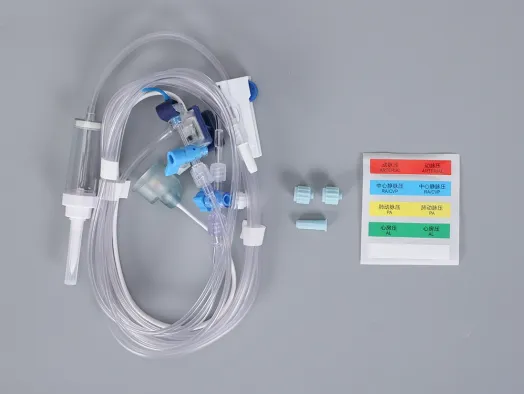
At the core of a disposable blood pressure sensor is a micromachined silicon strain-gauge bridge or a thin-film resistive element bonded to a diaphragm. When arterial pressure is transmitted through a fluid-filled line to this diaphragm, the mechanical deflection of the diaphragm changes the electrical resistance within the Wheatstone bridge configuration. The resulting voltage differential, amplified and digitized by the patient monitor's signal processing module, is converted into a pressure value measured in millimeters of mercury (mmHg). High-quality disposable transducers are designed to maintain linearity across clinically relevant pressure ranges — typically from approximately -30 mmHg to 300 mmHg — with accuracy tolerances within ±2% of reading, conforming to the performance standards defined under ISO 10651 and AAMI BP22 for disposable pressure transducers.
A critical engineering parameter is the sensor's natural frequency and damping coefficient, which collectively determine the fidelity of the reproduced waveform. An underdamped system will overshoot peak systolic values (resonance artifact), while an overdamped system will flatten the waveform and underestimate systolic pressure. SuJia's disposable blood pressure sensors are designed to deliver a flat frequency response across the clinically significant bandwidth — generally from DC to approximately 20 Hz — ensuring that hemodynamic waveform features such as the dicrotic notch, which indicates aortic valve closure, are faithfully reproduced.
The fluid path components of the disposable blood pressure sensor assembly — including the dome, Luer-lock ports, and flush device — are manufactured from medical-grade polycarbonate or ABS materials that are transparent to allow visual inspection for air bubbles, which can dampen the waveform and compromise accuracy. The dome is designed for a low-compliance fluid interface to maximize pressure transmission fidelity. The integrated continuous flush device, typically providing approximately 3 mL/hour of heparinized or normal saline flush, maintains catheter patency throughout monitoring without requiring manual flushing intervals. All fluid-path components are designed with smooth internal surfaces and minimized dead-space volumes to reduce thrombus formation risk and bacterial colonization potential.
From a cross-infection prevention standpoint, the disposable design of these sensors is not merely a regulatory convenience but a clinical necessity. Studies published in critical care literature have documented the risk of blood-borne pathogen transmission via reused or inadequately sterilized pressure monitoring components. Single-use design eliminates this risk pathway entirely, making SuJia's disposable blood pressure sensors the standard of care for institutional infection control programs. Each sensor arrives individually packaged in a sterile barrier system compatible with hospital receiving and sterile storage protocols.
Disposable blood pressure sensors from SuJia are configured with standardized cable interfaces compatible with major patient monitoring platforms and are available in single-channel and multi-channel configurations (for simultaneous arterial, central venous, and pulmonary artery pressure monitoring). Hemodynamic monitoring involving multiple pressure channels simultaneously is a routine requirement in cardiac surgery, cardiac intensive care, and trauma resuscitation settings, and the ability to source matched, calibrated sensors from a single manufacturer simplifies line management and documentation.
The shift from reusable to single-use patient monitoring consumables has been one of the clearest trends in hospital supply chain management over the past two decades, driven by converging clinical, regulatory, and economic forces. From the clinical perspective, the zero reprocessing requirement eliminates an entire category of device-related adverse events — including reprocessing failures, residual bioburden, and material degradation from repeated sterilization cycles that can subtly affect sensor performance over time. From the regulatory perspective, health authorities in major markets have progressively tightened oversight of reprocessed single-use devices, making validated single-use procurement a lower-compliance-risk strategy for hospital biomedical engineering and materials management departments.
From the economic perspective, the total cost of ownership calculation increasingly favors disposable sensors when all relevant cost inputs are included: reprocessing labor, sterilization validation, quality control testing after each reprocessing cycle, sensor replacement due to reprocessing-induced damage, and the liability exposure associated with healthcare-associated infections. SuJia's volume manufacturing capability — supported by our large-scale clean-room production environment and vertically integrated supply chain — translates into competitive unit pricing that makes the disposable model economically viable even in high-volume departments.
Our manufacturing practices align with the quality management principles described in ISO 13485:2016, the internationally recognized standard for medical device quality management systems. Production of monitoring consumables occurs in our Class 100,000 clean room, with environmental monitoring, in-process inspection, and finished goods testing protocols that produce documented traceability from raw material to finished sterile device. This traceability is essential for hospital materiovigilance programs and for regulatory submissions in markets that require device history records. Learn more about our engineering standards and innovation capabilities on our R&D page.
SuJia's monitoring consumables do not exist in isolation — they are part of an integrated portfolio designed to support the complete perioperative and critical care pathway. Hospitals and procurement agencies sourcing disposable monitoring sensors will often find value in consolidating additional consumable categories with a single trusted supplier. Our product range extends across General Anesthesia Category consumables — including breathing circuits, tracheal tubes, and LMA devices — as well as Infusion Category products such as infusion sets, extension tubes, and stopcocks. For patients requiring post-operative analgesic management, our Pain Management Category covers elastomeric and electronic infusion devices. Routine ward and post-acute care needs are addressed through our Nursing Care Category range.
This breadth of offering means that a hospital can source monitoring sensors, anesthesia consumables, infusion accessories, and nursing care products from a single quality-assured manufacturer, simplifying vendor management, reducing supply chain complexity, and streamlining the regulatory documentation required by hospital biomedical and procurement departments. For institutions operating across multiple sites or national health systems procuring at scale, consolidated sourcing from a certified manufacturer with the production capacity and international compliance credentials that SuJia maintains represents a meaningful operational advantage.
SuJia products are currently supplied to healthcare institutions in more than 30 countries and regions, with international partners spanning Europe, North America, Southeast Asia, the Middle East, and Africa. Our global logistics and regulatory affairs capabilities ensure that products reach end markets with appropriate local market authorization documentation and within cold-chain or ambient handling requirements as specified by the device's storage conditions.
SuJia Medical holds ISO 9001 quality management certification and ISO 13485 medical device quality management certification, complemented by CE marking for the European market and compliance with FDA requirements applicable to the relevant device classifications in the United States. We were among the first batch of Chinese medical device manufacturers to pass the National Medical Products Administration (NMPA) GMP pilot acceptance with high marks, a distinction that reflects our early and sustained investment in manufacturing quality infrastructure. The company has been continuously recognized as a National Key High-Tech Enterprise, and our collaboration with Zhejiang University through the Polymer Medical Devices Joint Research Laboratory demonstrates our commitment to science-based product development.
Our portfolio currently includes more than 80 registered patents, and we bring new patented innovations to market every year through a structured new product development process. For purchasers evaluating suppliers against quality and compliance criteria, our documentation package includes facility audit reports, device registration certificates, product test reports issued by accredited third-party laboratories, and sterilization validation summaries. These documents are available to qualified procurement and quality assurance contacts upon request.
Hospitals, group purchasing organizations, distributors, and OEM partners interested in our Disposable SpO2 Sensor or Disposable Blood Pressure Sensor are encouraged to reach our international business team directly. Our global sales contact is global@zjsj.com.cn, and our service hotline is +86-573-82222666. For product inquiries, sample requests, technical data sheets, and OEM cooperation discussions, please visit our Contact page. We also publish product updates, exhibition participation schedules, and company announcements through our News section, which we recommend following for the latest developments from SuJia Medical.
Choosing the right disposable monitoring sensor partner is a decision that touches patient safety, clinical workflow efficiency, supply chain reliability, and regulatory compliance simultaneously. SuJia Medical is positioned to meet all four dimensions with the depth of manufacturing experience, product engineering capability, quality management infrastructure, and global market presence that modern healthcare procurement requires.